
Discover how utilizing a 40′OQ (Open Top High Cube) In-Gauge solution over traditional 40′OT Over-Height (OH) slashed ocean freight surcharges for a 24 MT industrial transformer shipped from Shanghai to Constanta. Professional project cargo engineering, point-load distribution, and heavy-duty lashing.
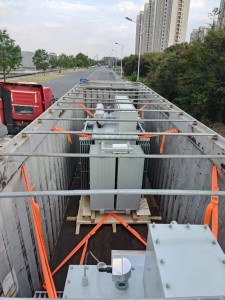
In project cargo logistics, shipping heavy-lift and out-of-gauge industrial machinery requires more than standard booking practices—it demands technical stowage engineering. For a recent shipment involving a 24 MT industrial transformer (dimensions: 6.6 × 1.8 × 2.6m) moving from Shanghai, China to Constanta, Romania, conventional freight forwarding would automatically default to a standard 40′ Open Top (40′OT) Over-Height (OH) container.
Instead of accepting hefty carrier slot-loss surcharges, our engineering team deployed an innovative 40′OQ (Open Top High Cube) In-Gauge (IG) strategy, drastically optimizing total landed freight costs while maintaining uncompromised transit safety.
1. The Bottleneck: Why Conventional 40′OT OH Inflates Freight Budgets
A standard 40′ Open Top container has an internal wall height of approximately 2.38m. Loading a 2.6m-high transformer immediately categorizes the container as Over-Height (OH).
In maritime container shipping, an Over-Height container creates “lost slots” (the container spaces directly above cannot be utilized for other containers). Ocean carriers compensate for this lost revenue by levying aggressive OOG (Out-of-Gauge) surcharges, specialized terminal handling charges (OOG THC), and restricted stowage approvals. On long-haul services connecting Asia to the Black Sea, these extra surcharges significantly inflate total transport expenditure.
2. The 40′OQ Breakthrough: Turning OOG into In-Gauge (IG)
By substituting the standard 40′OT with a 40′OQ (40-Foot Open Top High Cube) container, our project team altered the economic equation:
-
Eliminating Over-Height Surcharges: The 40′OQ design offers an internal height clearance of approximately 2.69m. At 2.60m, the transformer fits completely within the container’s physical structural envelope, qualifying the unit as In-Gauge (IG).
-
Top-Loading Convenience Without OOG Rates: The overhead opening allows gantry crane and overhead hoist loading at the factory or warehouse, bypassing the geometric constraints of a standard high cube box while avoiding open-top OOG penalty tariffs.
-
Accelerated Carrier Acceptance: Because In-Gauge units do not require vessel planners to sacrifice top-tier container slots, space confirmation and technical stowage approvals are processed substantially faster by the shipping line.
3. Marine Technical Execution: Load Distribution & Lashing Integrity
Transporting high-density static equipment across open seas requires meticulous structural stress planning to prevent dynamic shifts:
Engineered Heavy-Duty Wooden Sleepers (Point-Load Mitigation)
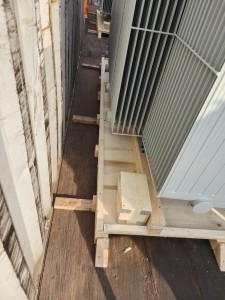
A concentrated 24-metric-ton load resting on four narrow contact points risks compromising the container’s wooden floorboards and cross-members. Our team calculated and positioned custom-milled, heavy-duty hardwood sleepers beneath the transformer’s skid frame. This precision dunnage evenly distributed the point-load across the longitudinal floor runners and transverse bottom steel beams, ensuring full structural integrity during severe sea-state rolling.
Engineered Logistics: Smarter Equipment Selection Drives Real Value
Project logistics efficiency is never about simply hunting down the cheapest baseline sea freight rate. True value is created when technical cargo parameters—dimensions, center of gravity, and weight distribution—are harmonized with container engineering.
By challenging standard industry assumptions and implementing a 40′OQ In-Gauge solution, we delivered an optimal balance: maximum structural safety, accelerated transit schedules, and significant freight cost savings.
Handling heavy-lift transformers, oversized industrial machinery, or specialized breakbulk cargo? Contact our project cargo engineering desk today to configure the most cost-effective routing and equipment plan.
Post time: Nov-09-2026